Plan International USA’s new organizational strategy boldly says that we will not just reach 10 million girls in the next four years but also ensure that they are co-partners to the process. To do this, we must not lose sight of the core principles of engagement.
The number of girls reached is certainly a valid question and helps us know how far along we are in terms of scale. But how we reach girls is an equally important question and one that defines the quality and potentially the results of that engagement. Who we reach is another critical question we constantly need to ask and assess since, often, the more difficult-to-reach girls are often those who are most in need—of education, schooling, health, skills, work, and protection. They may be excluded, stigmatized, or discriminated against as a result of social, economic, or physical reasons within their households or communities. Or they may be members of a community that is harder to reach because of geographic location, being an internally displaced person or a refugee.
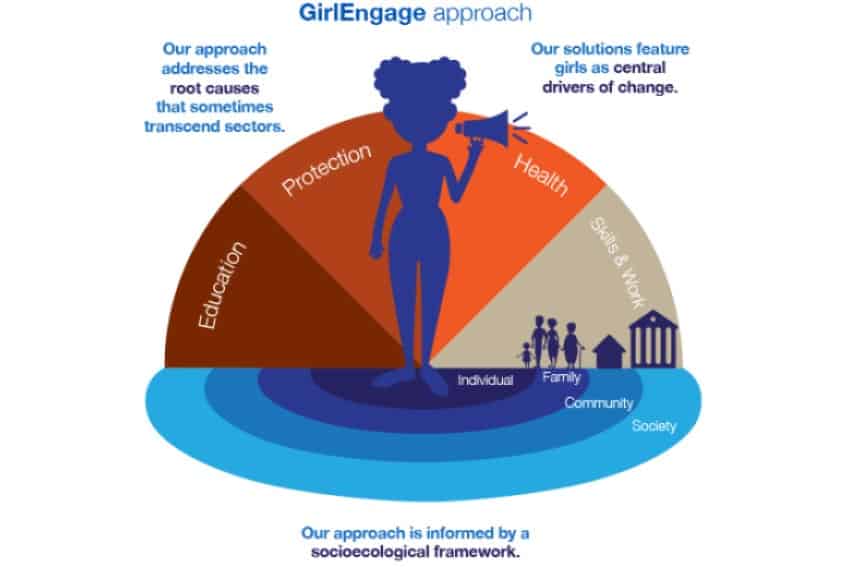
With this in mind, Plan has developed the GirlEngage approach. GirlEngage amplifies the voices of vulnerable and marginalized girls by including them in all stages of the project cycle, from setting goals to program evaluation. By engaging girls and young women as partners and co-designers, we co-create resilient solutions that reflect their priorities, needs, and vision. The best way to identify the challenges that girls and young women face on a daily basis and define their visions of success is to ask the experts, girls themselves.
With equality and engagement at the heart of our strategy, we are using human-centered design to underpin the GirlEngage approach. Human-centered design is, as the name would suggest, focused on the people within the design—in our case, the girls in our programs. Rather than “designing programs or solutions for,” it forces you to ask questions and to track a process with and through the eyes of the people who will be affected by this program. Empathy is an important element of the human-centered design process and GirlEngage in how we reach girls. This means that instead of just understanding a context, program staff are forced to understand the actual experience of that context, issue, or problem. To put it simply, you must understand the lived experience of girls themselves.
GirlEngage reflects the knowledge that girls don’t experience life according to program sections; their education might depend on their health, or their economic stability may depend on the culture in which they live. They are also not the only people impacted. Through initiating a girl’s journey toward self-reliance, we also make changes that benefit her peers, family, community, policy makers, and beyond. The approach integrates health, education, governance, protection, and economic empowerment.
GirlEngage in Action
Plan is piloting the GirlEngage approach in Senegal. Girls, chosen by Plan’s regional coordinator and their participation in a group called the Lingères (Lionesses), were invited to engage in a girl-centered design brainstorm to determine the type of programming they would like to see in their community. The assessment tool led girls to define obstacles and opportunities across key areas of their lives. In this particular community, the girls, along with other stakeholders, identified early child marriage as a key impediment to girls realizing their own dreams. Secondary school completion was also a central part of this vision.
Plan staff is returning to Senegal this summer to refine program design, and staff in the U.S. have begun fundraising for the initiative. Start-up is scheduled to begin in fall 2019.
Girl-centered design ensures that girls themselves have the power to create change.