As U.S. Agency for International Development (USAID) Administrator Mark Green has said, “When women do better, countries do better, communities do better and families do better.” Women’s empowerment is a core development focus. USAID’s lead on gender, Senior Deputy Assistant Administrator Michelle Bekkering, has added that “at USAID, we want every girl to go to school, to live in a home and community free from violence, and to receive the care she needs to grow healthy and strong.”
Research shows gender equality would generate tremendous resources for development. A new World Bank report found that limited educational opportunities for girls and barriers to completing 12 years of education will cost countries between $15 trillion and $30 trillion in lost lifetime productivity and earnings. This follows a 2016 McKinsey Global Institute report that found a “scenario in which women participate in the economy identically to men … would add up to $28 trillion, or 26%, to the annual GDP in 2025 compared with a ‘business-as-usual’ scenario.”
The enormous value of equality for women and girls, expressed by senior USAID leadership and demonstrated by research, should lead to the incorporation of gender equality throughout the agency’s ongoing reorganization and reform process. Two important places to demonstrate this are in leadership and staff positions focused on gender, and in identifying a central role for gender in USAID’s new self-reliance metrics, which chart a new vision for the agency.
Yet, Plan International USA’s analysis of USAID’s 17 self-reliance metrics found gender equality included in just one metric. It is understandable that USAID needed to make difficult decisions to keep the list of self-reliance metrics clear and manageable. Even so, the narrow measurement of gender seems to have missed opportunities — offered by the same data sources — to assess gender equality more meaningfully.
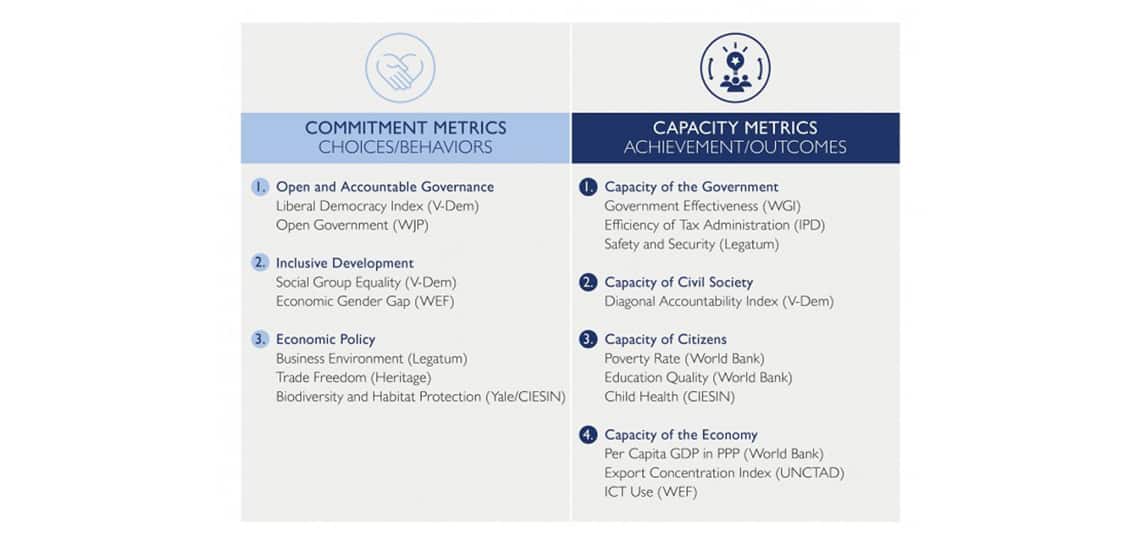
Overall, USAID has done well to choose publicly available, independent sources for the self-reliance metrics. Many of them are composite indices, so these have been disaggregated in our analysis below. At the end, we offer specific ideas to fill critical gender data gaps through the implementation of secondary self-reliance measurements. Here is USAID’s summary table of its self-reliance metrics:
Commitment metrics: Inclusive Development
Social Group Equality
“Social Group Equality in Respect for Civil Liberties” is a single indicator taken directly from the Varieties of Democracy Institute (V-Dem), which collects 71 indicators to conceptualize and measure democracy.
Through “Social Group Equality,” USAID can see the extent to which all social groups, “distinguished by language, ethnicity, religion, race, region or caste,” enjoy the same civil liberties. Separately, V-Dem also measures the extent to which all genders enjoy those civil liberties. However, USAID has not included that data within the self-reliance metrics.
Economic Gender Gap
USAID’s “Economic Gender Gap” metric originates from the Global Gender Gap Report of the World Economic Forum (WEF). That index measures 144 countries on their progress toward gender parity within four themes: economic participation and opportunity, educational attainment, health and survival, and political empowerment.
By choosing the “Economic Gender Gap,” USAID taps WEF’s economic participation and opportunity theme, which includes gender equality in the workplace, income, legislators, senior officials and management.
Yet, WEF’s Global Gender Report states “across these four different dimensions we see a number of positive interdependencies … that highlight the multifaceted nature of the benefits of increased gender parity.” If USAID hopes to holistically measure the gender gap, it should add the WEF’s other themes of educational attainment, health and survival, and political empowerment as secondary self-reliance metrics.
Capacity metric: Capacity of the Government
Safety and Security
USAID’s “Safety and Security” metric is based on the Legatum Prosperity Index 2017. The index has nine pillars to assess countries on the promotion of their citizens’ prosperity. The USAID metric includes the Legatum “safety and security pillar,” measuring countries’ national security, personal safety and security of living conditions. Although women and girls generally confront higher rates of violence, the Legatum Prosperity Index and USAID do not incorporate gender disaggregated data, missing this critical difference. To help fill that gap, USAID’s own Demographic and Health Surveys Program (DHS) is possibly the best existing open-source data on personal safety for women. DHS gender security indicators include:
— Physical or sexual violence committed by husband/partner in last 12 months
— Female genital circumcision
— Child marriage rates at ages 15 and 18
Another resource, already in use by the U.S. Millennium Challenge Corporation’s (MCC) Gender in the Economy Indicator, is the World Bank’s Women, Business and the Law (WBL) data on “Protecting Women from Violence.” This indicator examines the existence and scope of legislation on:
— Domestic violence
— Sexual harassment
— Marital rape
USAID should capitalize on the DHS and MCC indicators to provide a gender lens on safety and security.
Capacity metric: Capacity of Citizens
Education Quality
“Percentage of Students Attaining a Minimum Proficiency in Reading at the End of Primary School” from EdStats (World Bank) is USAID’s proxy indicator for education quality that measures student achievement in reading through comparative cross-country international tests. This data, collected by UNESCO and disseminated by the World Bank, is disaggregated by gender.
It’s a good start, but should be complemented by assessing factors like girls’ enrollment and completion of secondary education. This is critical given the high secondary school dropout rates for female students in many countries. To fill that data gap, USAID should consider other measures of education quality, also collected by UNESCO and found in EdStats by the World Bank:
— Gross enrollment ratio, secondary, female (%)
— Gross graduation ratio from lower secondary education, female (%)
Next steps: Elevating gender equality through secondary self-reliance metrics
This analysis shows that, currently, USAID’s self-reliance metrics are primarily gender neutral or gender blind. To not treat the subject of gender holistically is a disservice to USAID’s own commitments to gender equality and female empowerment. These gaps undervalue the role of gender equality in generating countries’ progress towards self-reliance.
Thankfully, several remedies seem to be available. In addition to USAID’s own DHS surveys and gender analyses, Plan’s research has identified several gender indicators already available from the same data sources USAID has chosen for the 17 self-reliance metrics. These can be added as secondary metrics:
— Global Gender Gap Report, World Economic Forum
— Protecting Women from Violence, WBL, World Bank
— Gross enrollment ratio, secondary, female (%), EdStats, World Bank
— Gross graduation ratio from lower secondary education, female (%), EdStats, World Bank
Given the priority placed on gender equality by USAID leaders like Mark Green and Michelle Bekkering, as well as the trillions in economic benefits that gender equality would generate, the agency needs to holistically consider gender in its self-reliance metrics. The significant gender data gaps described here show that much work will be needed to effectively measure gender equality through USAID’s secondary self-reliance metrics and by other means. Now is the time for the agency to act to fill this gender data gap and ensure gender equality is truly central to USAID’s transformation and to its partner countries’ journeys to self-reliance.