Meet the first female school director in an Ethiopian refugee camp
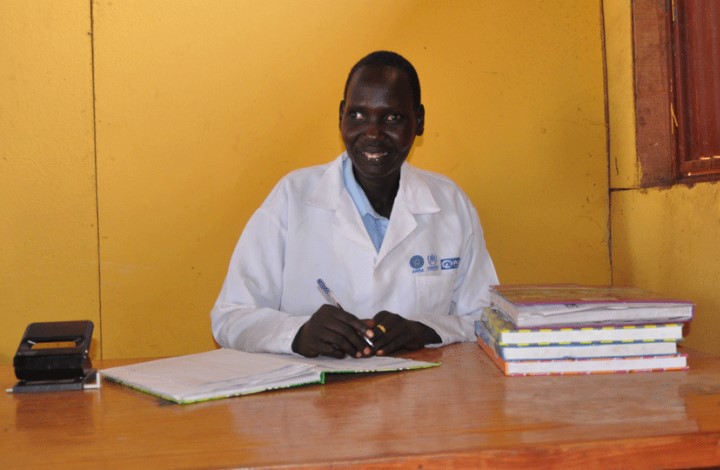
At 32 years old, Rachel has overcome traditional barriers and customs to become the first female school director in an Ethiopian refugee camp, and she has put plans in place to encourage more girls to attend school.
It hasn’t been an easy road for her.
When her parents were killed in Sudan’s civil war, the longest in Africa’s history, Rachel, then 8, was taken to Kenya by her aunt. They made their home in a refugee camp where Rachel attended primary school. When South Sudan gained independence, they returned to their new country, optimistic that their lives would be peaceful.
At first, everything went well. Rachel completed her secondary school education and studied nursing at college, graduating with a diploma. She loved her career as a nurse and after marrying her husband, she had two children.
But when South Sudan became engulfed in conflict, things quickly began to change.
“When the war broke out in my county, I was in my village alone with my two children while my husband was working in Juba, and that was how we became separated,” she said.
Rachel quickly realized that she would have to leave her village.
“Things changed, there was destruction and killing everywhere,” she said. “We didn’t have any choice other than to flee to save our lives.”
Since December 2013, conflict in South Sudan has claimed thousands of lives and driven nearly 4 million people from their homes. While many remain displaced inside the country, more than 2 million have fled to neighboring countries in a desperate bid to reach safety.
Pregnant with her third child, Rachel and her children walked for two months to reach Ethiopia. During the difficult journey there, Rachel gave birth.
In Ethiopia, the family was sent to live in a refugee camp in Gambella, and Rachel wanted to get her older children into school.
“Here, Plan International is providing us with education,” she said. “We had no way to educate our children in South Sudan.”
With financial support from the EU under the Building Resilience in Crises through Education (BRiCE) program, Plan is providing education for South Sudanese refugee children in Gambella with the support of the local community.
Rachel was also able to benefit from the BRiCE project, having been selected to receive training in school management. The course teaches participants how to effectively provide children living in difficult situations with quality education, as well as how to undertake gender-sensitive school improvement plans to provide children with a safe learning environment.
She was named the school’s director and aims to keep girls in school.
“Because of challenges at home, girls were not attending school,” she said. “Women had no power to complain about their rights because of their lack of knowledge, but this opportunity gives me the chance to change this and has made me a role model for the community.”
By working with the local community, particularly mothers, the project aims to get more girls into school and prevent them from dropping out early. Limited access to education perpetuates and magnifies the challenges of refugee girls—finding work, staying healthy, and holding on to dignity and hope. It also reduces their potential to rebuild their lives, protect themselves against abuse, and take a lead in shaping their communities.
“There are girls and young women who are suffering in this camp now. The little knowledge that I had from being a refugee in Kenya has helped me to escape violence in this camp. The reason women are vulnerable here is their lack of knowledge,” she said.
“It’s learning that has brought me this far,” she added. “The situation here is far better than in South Sudan, so parents and children need to understand the value of education and that is why I am here, to advocate for a safe learning environment for the refugee community, particularly for girls.”